
Cattell's theory of Personality (Trait Theory)

Trait Theory

Trait theorists believe personality can be understood by positing that all people have certain traits, or characteristic ways of behaving. A trait is an identifying characteristic, habit or trend. Saying that a trait is either present or absent does not accurately reflect a person's uniqueness, because according to trait theory all of our personalities are actually made up of same traits. We differ only in the degree to which each trait is expressed.
Cattell believed it necessary to sample a wide range of variables to capture a full understanding of personality. The first type of data was life data, which involves collecting information from an individual's natural everyday life behaviors.
Experimental data involves measuring reactions to standardized experimental situations and Questionnaire data involves gathering responses based on introspection by an individual about his or her own feelings.
Using this data Cattel performed factor analysis to generate sixteen dimensions of human personality traits:
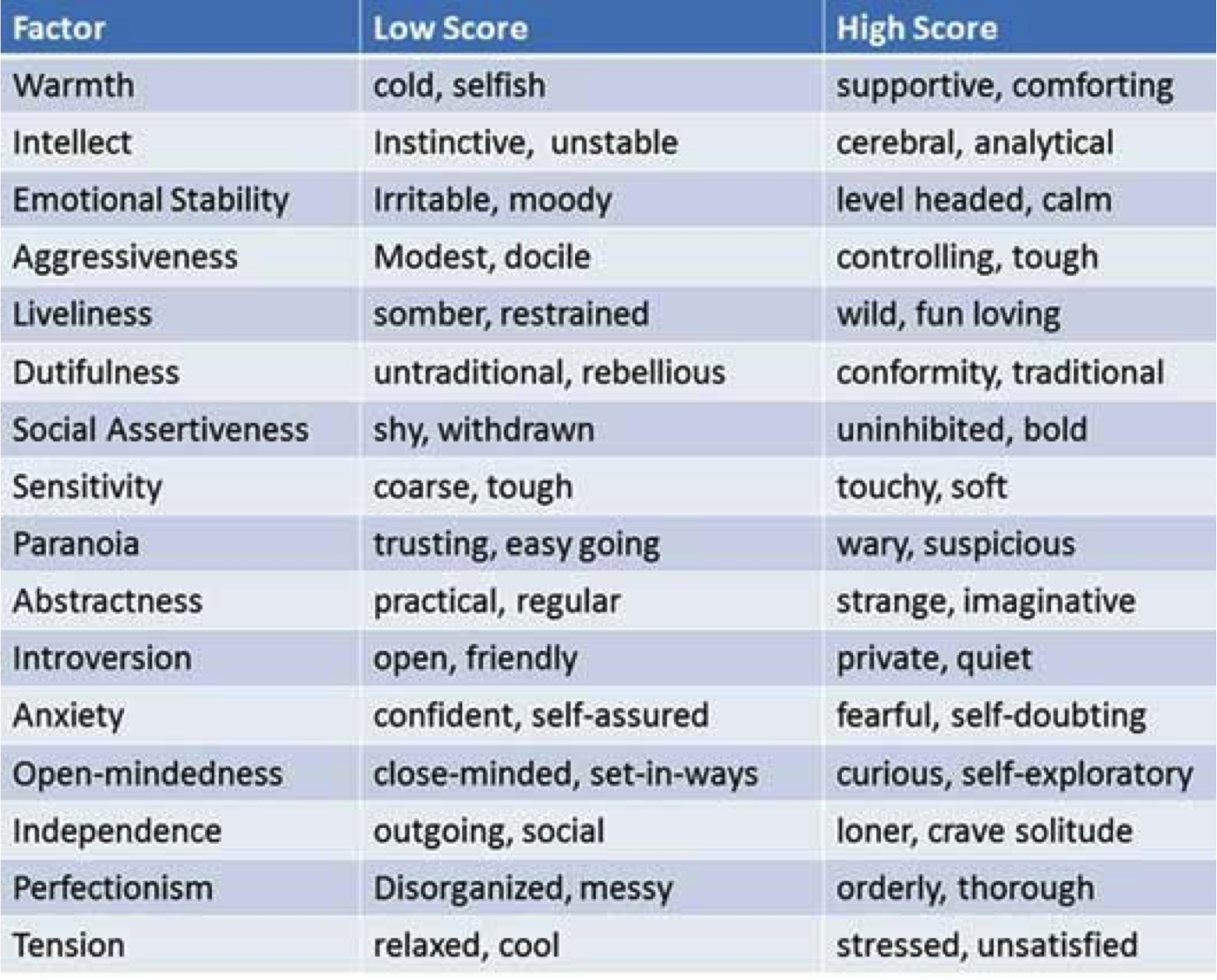

Based on these 16 factors, he developed a personality assessment called the 16PF. Instead of a trait being present or absent, each dimension is scored over a continuum from high to low. For example, your level of warmth describes how warm , caring and nice to others you are. If you score low on this index, you tend to be more distant and cold. A high score on this signifies you are supportive and comforting.

Comments

  1. This comment has been removed by the author.

    ReplyDelete
  2. Great explanation of Trait Theory and how personality traits exist on a continuum rather than being simply present or absent. Understanding personality dimensions like this can also help in creating a healthy Narcissistic Recovery Plan, because recognizing behavioral patterns and traits makes it easier for survivors to understand toxic dynamics and begin emotional healing. This is very insightful for psychology students and anyone interested in personality development.

    ReplyDelete

Post a Comment

Popular posts from this blog

Sheldon's Theory of Personality (Type Theory)

Intro In the 1940's, William Herbert Sheldon associated body types with human temperament types. He claimed that a body type could be linked with the personality of that person. He says that a fat person with a large bone structure tends to have an outgoing and more relaxed personality while a more muscular body typed person is more active and aggressive. A slim or scrawny person with thin muscles is usually characterized as quiet or fragile. He split up these body/personality types into three categories called somatotypes. Endomorphic An Endomorphic somatotype is also known as a viscerotonic. The characteristic traits of this somatotype usually includes being relaxed, tolerant, comfortable, and sociable. Psychologically, they are also fun loving, good humored,even tempered, and they love food and affection. The Endomorph is physically "round". They have wide hips and narrow shoulders that give a pear shape. They tend to have a lot of extra fat on their body a...

Deficit Theory (Eller, 1989)

The Deficit Theory attempts to explain why certain disadvantaged students show a high failure rate in school. These students coming from socio-economically disadvantaged homes, show a lack of verbal stimulation and entered school without the necessary linguistic resources for success. These children, labelled verbally deficient may actually be highly competent language user, however they do not find themselves in situations where they are able to demonstrate their specific language competence. When a child is in the presence of an authority figure of a different social class, he or she tends to be more introverted. An important consideration for those working with high school students is to realize that one vernacular (language) is not inherently superior to another. Such understanding will enhance a students' desire to develop during there years of critical language growth. In an attempt to explain deficiencies in lower socioeconomic students’ success rate, some researc...

B.Ed. Notes - Guilford’s Structure of Intellect

Joy Paul Guilford was a US psychologist, best remembered for his psychometric study of human intelligence, including the important distinction between convergent and divergent production. His "Structure of Intellect" model organized these various abilities along three dimensions: content, product, and process. He sought to develop tests for each combination of the possibilities on these three dimensions, expecting that a person could be high on some of these abilities while being low on others. According to him, Intelligence depends on: Mental operations (process of thinking) Content (what we think about) Product (result of our thinking) By Content he meant that different people seemed to pay more attention to and think more effectively about different kinds of information. There are 5 kinds of Contents Visual - Information perceived through seeing Auditory - Information perceived through hearing. Symbolic content  - arbitrary signs such as numbers or co...